
What New Haven Deed Records Convey
A recorded instrument in New Haven can transfer an interest, release a claim, secure a debt, or add another notice to the land records. Connecticut clerks file deeds alongside mortgages, releases, quitclaims, liens, easements, and maps. Those pieces form one record set. A complete ownership chain is never just sale deeds.
| Deed Type | What It Does | Common Use |
|---|---|---|
| Warranty deed | Conveys the stated interest with deed covenants | An arms-length transfer |
| Quitclaim deed | Conveys the grantor's stated interest without the same covenants | Changing or clarifying interests |
| Fiduciary deed | Records a transfer by an authorized estate fiduciary | Estate property |
| Mortgage or release | Creates or releases a recorded security interest | Following encumbrances |
| Map or plan | Records a referenced layout or parcel plan | Reading deed descriptions |
A mortgage or lien is not a deed. Even so, it shapes the record trail. So can a release, assignment, probate filing, or map cited by a deed, so read each instrument and its cross-references.
New Haven SearchIQS Deed Index
The New Haven City Clerk SearchIQS portal opens its index to guest searches. Local coverage help lists land records from July 26, 1951 to the present. Maps run back into the nineteenth century. The exact image cutoff is unclear. The help page and the detailed index differ on how early image-backed material goes, so view the image rather than assuming every indexed map is online.
| Search field | What it locates | Useful limit |
|---|---|---|
| Grantor | A party conveying an interest | Name spelling and date range |
| Grantee | A party receiving an interest | Entity and name variants |
| Document type | Deeds, releases, liens, maps, and other classes | Do not narrow too soon |
| Book/page | A known volume reference | Copy both numbers exactly |
| Instrument number | A specific indexed filing | Confirm the municipality |
An index row is only a finding aid. Images may require an account or subscription, and the City Clerk provides official copies, so keep the index date, image status, and recording reference together.
Waterbury and Meriden Deed Routes
The Waterbury Town Clerk land-record page links its SearchIQS route and recording information. A separate clerk page covers in-person research, phone and email help, copy requests, and remote access described for professionals. The page does not state how far back the online records go, so confirm older dates with the clerk.
The Meriden NewVision search is free. Meriden charges $70 for a first page, $5 for each added page, and $160 for a MERS or nominee first page. Copies run $1 per page. Certification adds $2, and maps cost $3. Free searching is not a certified copy. Know what you need: an index row, plain copy, certified copy, map, or new recording.
Meriden City Clerk sits at 142 East Main Street. Hours are weekdays, 8:00 a.m. to 5:00 p.m. Waterbury sets its own prices and turnaround through its clerk channel. No one city's fees govern countywide. Figures from one city never apply across New Haven County.
Follow New Haven Grantor-Grantee Links
Grantor and grantee fields string separate deed records into a sequence. Start with a current owner spelling from the local assessor, but only as a lead. Find that owner as grantee on the latest plausible acquiring deed. Read it for the parcel description and prior party, who becomes your next grantee search.
- Search the likely current owner as grantee and limit plausible results by date.
- Open the newest deed tied to the legal description, then copy its grantor and reference.
- Search that grantor as an earlier grantee and match the description, map, or cross-reference.
- Repeat while noting gaps, name changes, estate events, lot splits, and the online cutoff.
- Grantor
- The party conveying the stated interest.
- Grantee
- The party receiving that interest.
- Chain of title
- The linked sequence of instruments affecting the same land.
- Book/page
- A volume reference; an instrument number is a separate filing reference.
The grantor is not always a conventional seller. A trustee, estate fiduciary, municipality, authority, or entity may hold that role, and execution and recording dates can differ.
See New Haven Deed Coverage
The SearchIQS coverage help lists New Haven deed coverage.
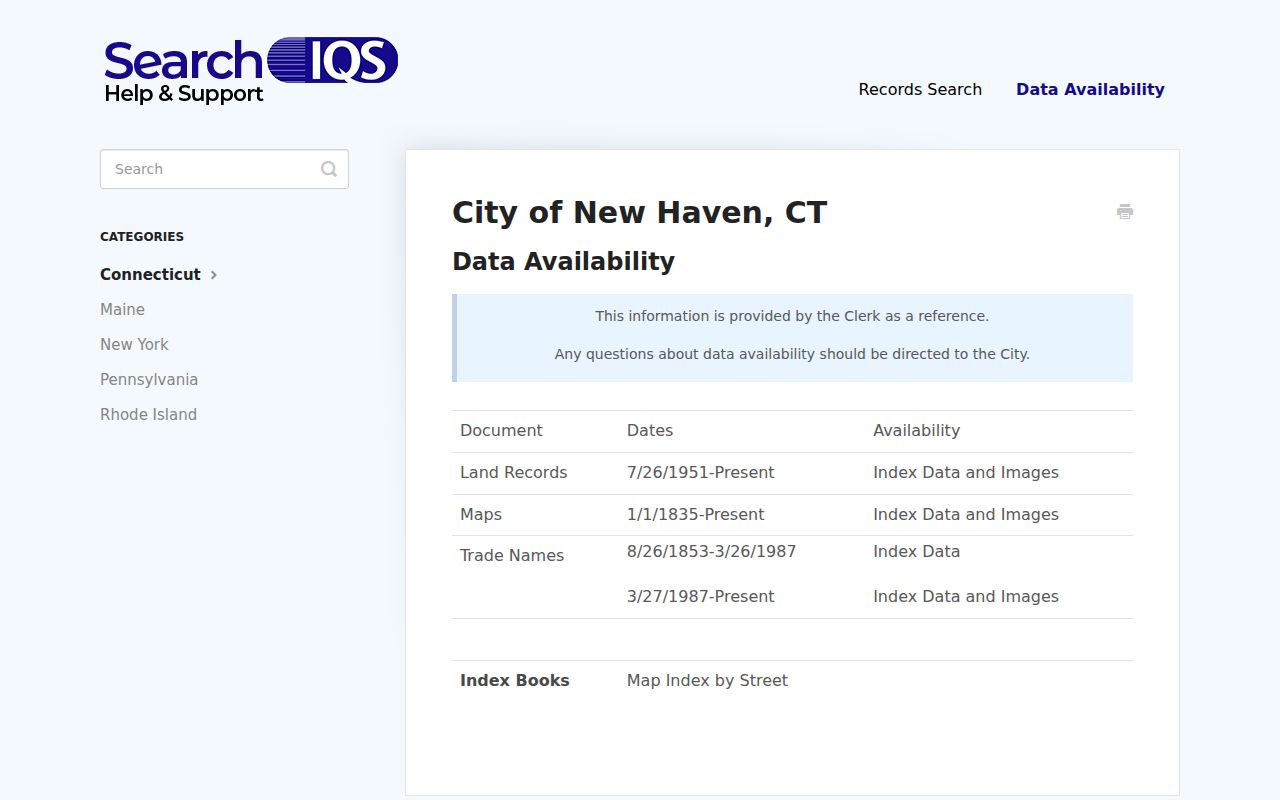
That page sets the stated online starting point. A particular older deed or missing image still means a trip to a clerk, library, or archive.
Older New Haven Ownership Evidence
Chains before 1951 depend on municipal deed books, maps, and local history sources. The New Haven Free Public Library local-history collection offers newspapers on microfilm and maps. New Haven Museum's Whitney Library holds city directories from 1830 through 1993. It also holds manuscripts, maps, photographs, and books. A directory can link a name to an address. It is not a deed, though.
State Archives holds New Haven County Court material from 1666 to 1855. That label is historically sound even though modern county government keeps no deeds. Court and probate files can explain an estate or partition. The municipal instrument remains the land-record reference.
A New Haven grant described an $11,000 digitization project using aperture cards and map books. It documents an access project, not universal online availability. Ask which series and dates are retrievable now.
Historic district recordings bridge old references to the clerk index. New Haven's official district material cites Wooster Square at land-record volume 2427. The pages run 763 through 766. Quinnipiac River sits at volume 2751, pages 29 through 32. City Point is at volume 5844, pages 44 through 50. Treat those citations like any book-and-page reference. A later Certificate of Appropriateness is a separate land-use record. It is not the instrument that recorded the district action.
Older roads and lots may carry former labels. Capture the map title, date, volume or plan reference, lot label, adjoining-owner calls, and municipality. Then compare them with the modern parcel map. The current GIS polygon is not a legal survey. A split, merger, condominium declaration, road relocation, or common element can demand several linked instruments. The same land becomes recognizable only after those.
Meriden Exact-Name Deed Alerts
Meriden runs a free alert service worth knowing about. The Meriden Property Alert sends an email whenever a newly indexed land record names a registered party exactly. Signing up takes a name, an email, and a password. Once the clerk verifies the match, the alert carries an instrument number. You can pull that number directly.
Name matching is literal, so register variants. A different middle initial, hyphen, spacing, or suffix needs its own entry. Companies can be registered under their company names. Treat any alert as a prompt to open the instrument itself. It is not proof of fraud, and it is no substitute for title insurance. The other New Haven County clerks publish no equivalent named alert. The service covers Meriden records only, not the county.
Obtain a New Haven Deed Copy
Start by writing down what identifies the record. List the municipality, parties, document type, date, and the book/page or instrument number. Then choose your route. An online image may be available. The clerk counter works for walk-ins. Mailed or certified copies can also be requested. The New Haven City Clerk sits at 200 Orange Street, Room 202. It is open weekdays 9:00 a.m. to 5:00 p.m., with recording through 4:00 p.m. Waterbury handles copies by phone, email, in person, copy request, or professional remote channels. Meriden posts its own copy and certification fees.
When a record seems missing, send a focused Connecticut FOI request to the custodian who actually holds it. Include the address, parcel or map-lot, parties, record type, and date range. A request addressed only to New Haven County will likely be misdirected.
Recorded, not guaranteed. An index shows filed instruments, not a legal opinion about title or every possible unrecorded interest.
A certified copy authenticates the reproduction the clerk holds. It says nothing about the deed's legal effect. If the goal is a full backward reconstruction, use the former-owner chain workflow instead.
Requests work best when they name the exact deliverable. An index result lists searchable facts but may omit the operative text. A plain copy reproduces the recorded pages. A certified copy adds the clerk's authentication. A map reproduction is a separate product, which is why Meriden prices copies, certification, maps, and recording as distinct charges. Ask New Haven or Waterbury directly for current copy prices and delivery rather than borrowing Meriden's schedule.
Deeds cite other instruments. A single document may point to a mortgage, release, assignment, lien, easement, map, or prior deed. Collect every cited reference before leaving the portal or counter. A release transfers nothing, but it can clear an encumbrance from earlier in the chain. An assessor sale row is only a lead. Open the deed named by its book/page and compare party names, legal description, dates, and stated consideration.
Estate property can add a second custodian. Connecticut Probate case lookup covers online cases from January 5, 2011 forward and may surface a district, fiduciary, inventory, or order. The court file explains the authority behind a later executor or administrator deed. The municipal clerk record shows the conveyance itself. Keep both dates, and do not mistake the probate index for a deed record.