
Decode New Haven County Property Value
New Haven County has 500,000+ residents. Assessors and clerks in each town keep the property value records. The assessor estimates fair market or appraised value as of a set valuation date. The office then applies the statutory assessment level. A deed or an assessor sales table can also show what a parcel last sold for. Keep those figures in separate columns. They answer different questions about the same parcel.
| Value Type | What It Means | Where It Is Recorded |
|---|---|---|
| Market or appraised value | The assessor's full-value estimate as of a set date | Municipal assessor card |
| Assessed value | The amount used as the tax base, generally 70 percent of fair market value | Grand List and assessor card |
| Last sale price | The consideration associated with one transfer, which may be nominal | Recorded deed or assessor sales history |
| Land and improvements | Separate components for land, buildings, and outbuildings | Municipal CAMA record |
Connecticut's inspected municipal sources apply a 70 percent assessment level to real estate. Assessed value is therefore a tax-administration figure, not a market opinion. A sale can close well after the valuation date. But a revaluation can rewrite the record without any sale at all. Exemptions and penalties may shift taxable treatment too. Even so, the displayed assessment can stay the same.
New Haven County Value Fields
The New Haven VGSI assessment database identifies the 2021 revaluation. It also notes the October 1, 2021 assessment level. One caveat matters here. Exemptions and penalties are not reflected in the displayed assessed values. A sample field card still gives you plenty. It covers ownership, map and account IDs, land and building data, assessments, sales, permits, and notes.
The public assessor search and its result layout show how these fields appear on screen. Open the official database and check the current record before comparing any figures.
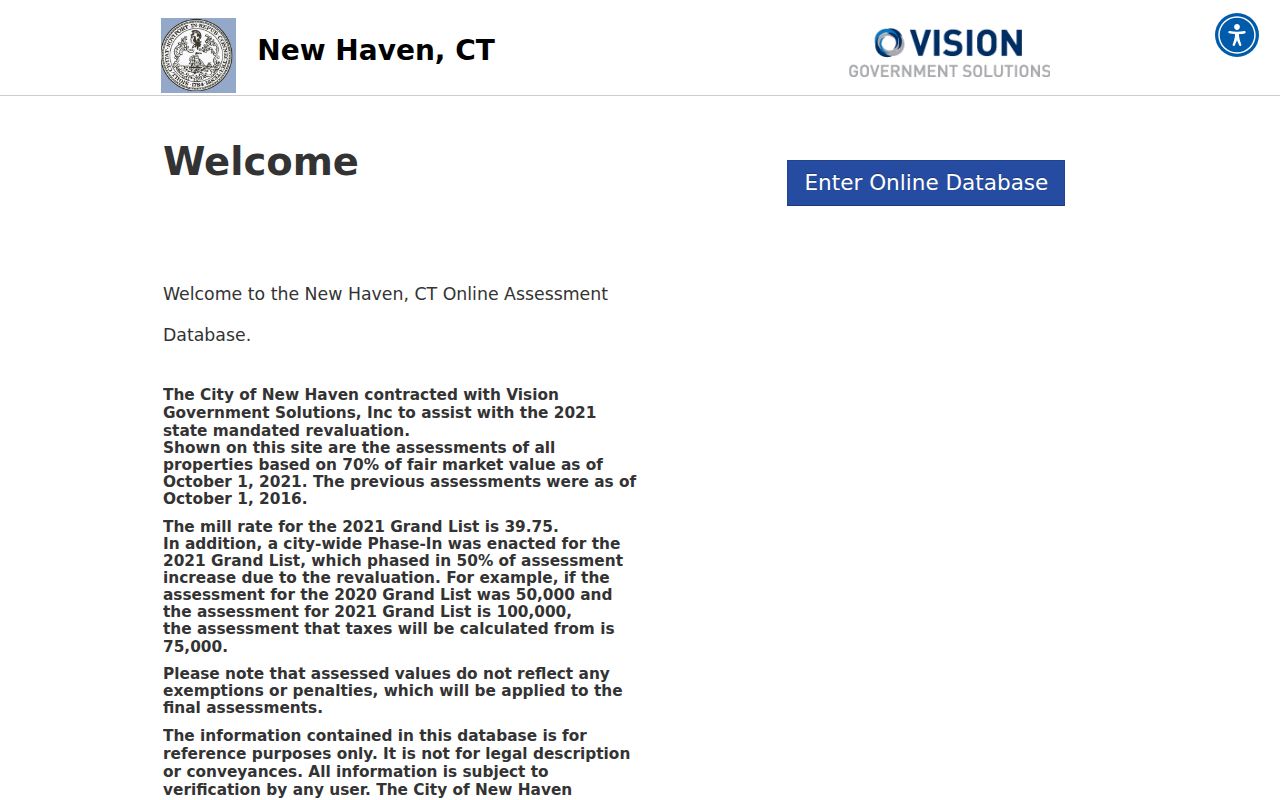
Treat the screen as a discovery source only. Preserve the Grand List year and valuation basis, because an owner or price shown elsewhere may be newer than the record you first pulled.
Meriden Shows the Ratio
Meriden's sample assessor card makes the ratio easy to check. Total appraised value reads $6,912,800. Total assessed value reads $4,838,960, exactly 70 percent in that sample. Land, building, and outbuilding components stay listed separately. The card also carries a sales-history row dated March 3, 1997, priced at $0, with book 2245 and page 296.
Do not call that $0 row market value. It is a dated sales-history entry tied to a transaction and instrument reference. Other Meriden records show real sale prices with book and page. So transfer dates belong beside every number.
One parcel is not a citywide trend. See the Meriden sample assessor card for its layout.
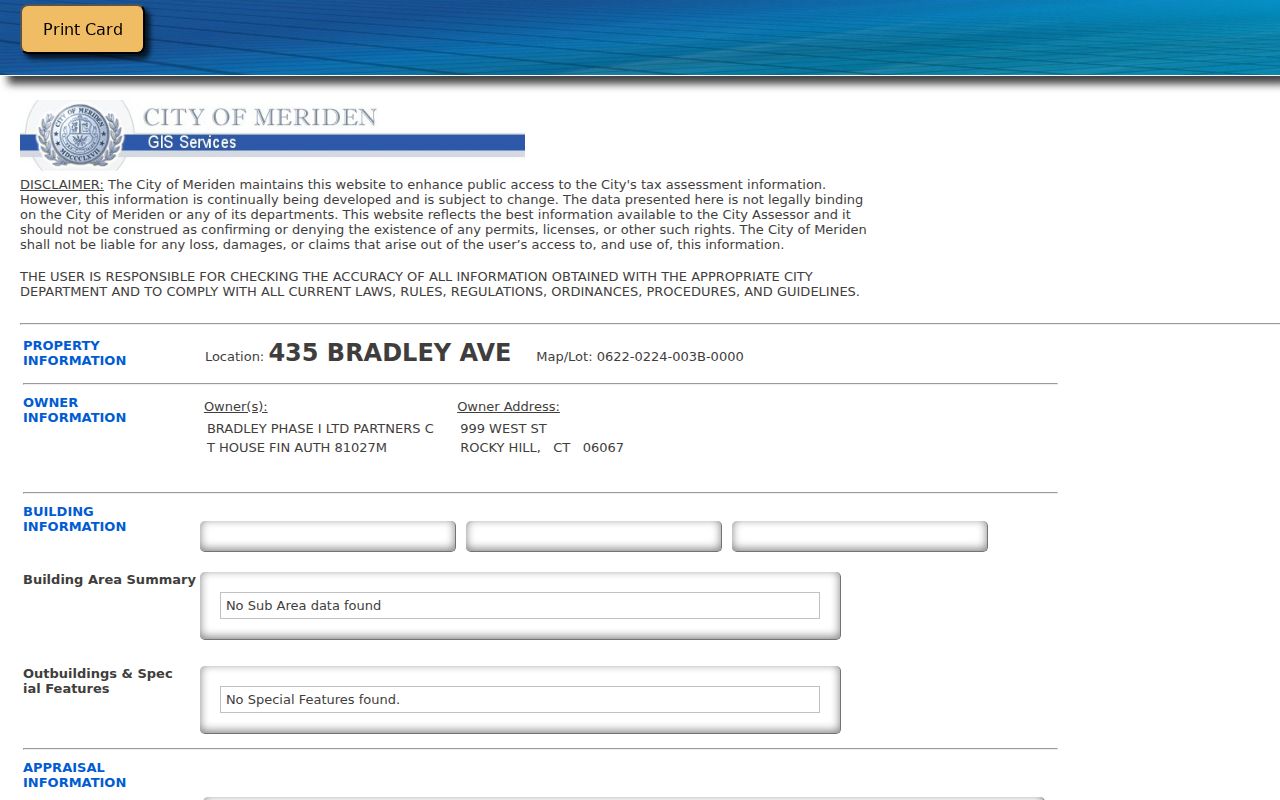
The official card keeps valuation and sale history apart. That separation lets you compare values by source and date instead of accepting one blended figure.
Look Up New Haven County Values
Start with the legal municipality. Connecticut abolished county government. There is no New Haven County assessor to call, so the town or city card is the core source for any property search. Keep the lookup narrow, and copy each label exactly instead of converting a displayed number into an estimate of today's sale price.
- Search the municipal assessor or GIS portal by address. Copy the parcel or account key exactly, including leading zeroes and letters.
- Record the Grand List year, valuation date, land, building, outbuilding, appraised, and assessed fields as labeled.
- Open the sales-history entry and municipal land record. Save the sale date, price, deed type, book and page, grantor, and grantee.
- Compare only like records: the same parcel, value basis, component, and valuation year, with changes in construction or ownership noted.
- Assessed value
- The tax-base amount placed on the municipal Grand List.
- Market or appraised value
- The assessor's estimate of full value as of its valuation date.
- Assessment ratio
- The percentage connecting assessed value to fair market value, generally 70 percent in Connecticut municipal records reviewed.
- Consideration price
- The amount tied to a deed transfer; it may be nominal, exempt, missing, or shaped by the transaction.
- Reassessment
- A new value determination or update for tax administration, which can occur without a sale.
New Haven 2026 Revaluation
New Haven keeps its assessments at the 2021 level for 2021 through 2025. The current revaluation targets October 1, 2026. The process uses field review plus the cost, income, and sales-comparison approaches. Preliminary notices are expected in late November. Informal vendor hearings follow, then final values and a Board of Assessment Appeals route.
This is a process, not a finished Grand List. Final 2026 values must wait for official publication. Keep that time distinction in any New Haven County property value research. A deed can post before the new assessment lands. Revaluation can also change assessed value while the owner of record stays the same.
Meriden Uses Another Calendar
Meriden's official VGSI notice says the 2025 revaluation reflects fair market value as of October 1, 2025 and assesses at 70 percent. Informal hearings had ended, second notices were issued February 27, 2026, and written board appeals were due March 20, 2026. The city warned users not to apply the current mill rate to the new assessment.
This difference matters across New Haven County. A Meriden property value cannot be placed on New Haven's 2026 schedule, and neither can establish Waterbury's revaluation date. The official Waterbury research confirmed the 70 percent ratio and property search, but not a comparable numeric trend series.
Note: One assessor card is a parcel example, not a valid citywide or countywide market trend.
Sales Need Transfer Context
A recorded price is historical evidence, not an automatic current value. Family transfers, fiduciary deeds, and redevelopment deals can all skew the numbers. Financing terms can do the same. The result may be a nominal or odd consideration. Match each price to its recording and transaction dates. Note the deed type, the parties, and the book and page. Then set that against the valuation date on the assessor card.
The sample records show how each city handles this. New Haven exposes sale price and date fields. Meriden's sales table adds sale date, price, book, page, grantor, grantee, and deed type. Waterbury keeps Sales History and Property Value apart. The layouts differ, but the rule holds. Never merge a sale price and an assessment into one number.
The town clerk controls the recorded instrument itself. An assessor's sales row is a handy index. When transfer terms matter, confirm the row against the deed.
Limits of New Haven County Property Value
An assessor values thousands of parcels at once using mass-appraisal methods. All values are pinned to a fixed date. The numbers serve tax administration. They are not an inspection. A mass appraisal cannot weigh every private condition. It never guarantees what a buyer will actually pay. One more wrinkle: the displayed owner of record may reflect the Grand List date. A newer deed may already name a different grantee. Match the value to the question you are asking.
For a purchase or sale, rely on current property facts and an independent licensed appraisal. For a tax dispute, keep the assessor's value date and the municipal procedure in view. The separate New Haven County property tax record covers bills, liens, and appeals.
Value vs price. New Haven County assessed value serves taxation. It is not a sale forecast or a property-specific appraisal.
Compare Values Without Guessing
Build a four-part worksheet for each New Haven County property value. List the market or appraised reference, the assessed value, and the taxable treatment. Add the recorded sale price. Beside each entry, note the source, the municipality, and the valuation or recording date. Add the Grand List year too. Keep land, building, and outbuilding components intact rather than collapsing them into one figure.
Flag any permits or construction that could shift a future building component. Note exemptions separately, because a database can leave them out. If the owner field and the newest deed grantee disagree, keep both dates on file. Keep the assessor update or list date. Keep the deed recording date as well. Choosing one as current without proof invites error.
No countywide value-trend series exists. New Haven and Meriden publish clear revaluation snapshots. Waterbury's inspected official sources supply the ratio and property search route but no multi-year series. That gap is more trustworthy than a trend inferred from three sample parcels.
When a value field is missing online, ask the municipality for the existing assessor card or Grand List entry. State the valuation year you need. Connecticut FOI is a custodian route, not a county valuation service.