
Sources for New Haven Former Owners
Which source fits depends on the era and the municipality. The newest deed gives you the next name in the chain. Older deed records stretch the chain further back. Plat maps and city directories untangle renamed streets. Probate files explain why a fiduciary rather than the owner of record signed a later deed.
| Source | Years It Covers | Where Held | What It Shows |
|---|---|---|---|
| New Haven SearchIQS | July 26, 1951 to present | City Clerk portal | Parties, dates, types, references |
| Municipal deed books | Before the web floor | Town or city clerk | Earlier recorded transfers |
| New Haven maps | Nineteenth century forward | Clerk and map books | Plans and lot context |
| Directories and microfilm | Collection-specific | Library or museum | Address and occupant context |
Waterbury runs its property search through a separate SearchIQS route, and Meriden uses NewVision. Confirm each system's coverage on your own. New Haven city's online start date reflects that city alone, not a county rule.
Reconstruct New Haven Owners Backward
Treat an assessor name as nothing more than a lead. Meriden cautions that assessor ownership can lag behind City Clerk deed records. Find the newest deed matching the legal description, then turn that deed's grantor into your next grantee search.
- Confirm the legal municipality and copy the parcel key.
- Find the newest acquiring deed with the likely owner as grantee.
- Copy grantor, recording date, deed type, and reference.
- Search that grantor as an earlier grantee and repeat.
- At the online floor, continue in clerk books and maps.
- Grantor and grantee
- The parties conveying and receiving the stated interest.
- Chain of title
- The linked instruments affecting the same land.
- Reverse index
- An index used to find when a party acquired an interest.
- Legal description
- Deed text that outlasts a changing street address.
A quitclaim and a warranty deed carry different covenants. Neither label alone proves the whole chain. Match legal descriptions and follow the cross-references carefully.
New Haven's 1951 Online Floor
The New Haven SearchIQS help lists land records running from July 26, 1951 to the present. Guest access shows names, dates, instrument types, and references. Images may require an account route instead. Map coverage reaches back further, though the source wording varies on how old images can be viewed.
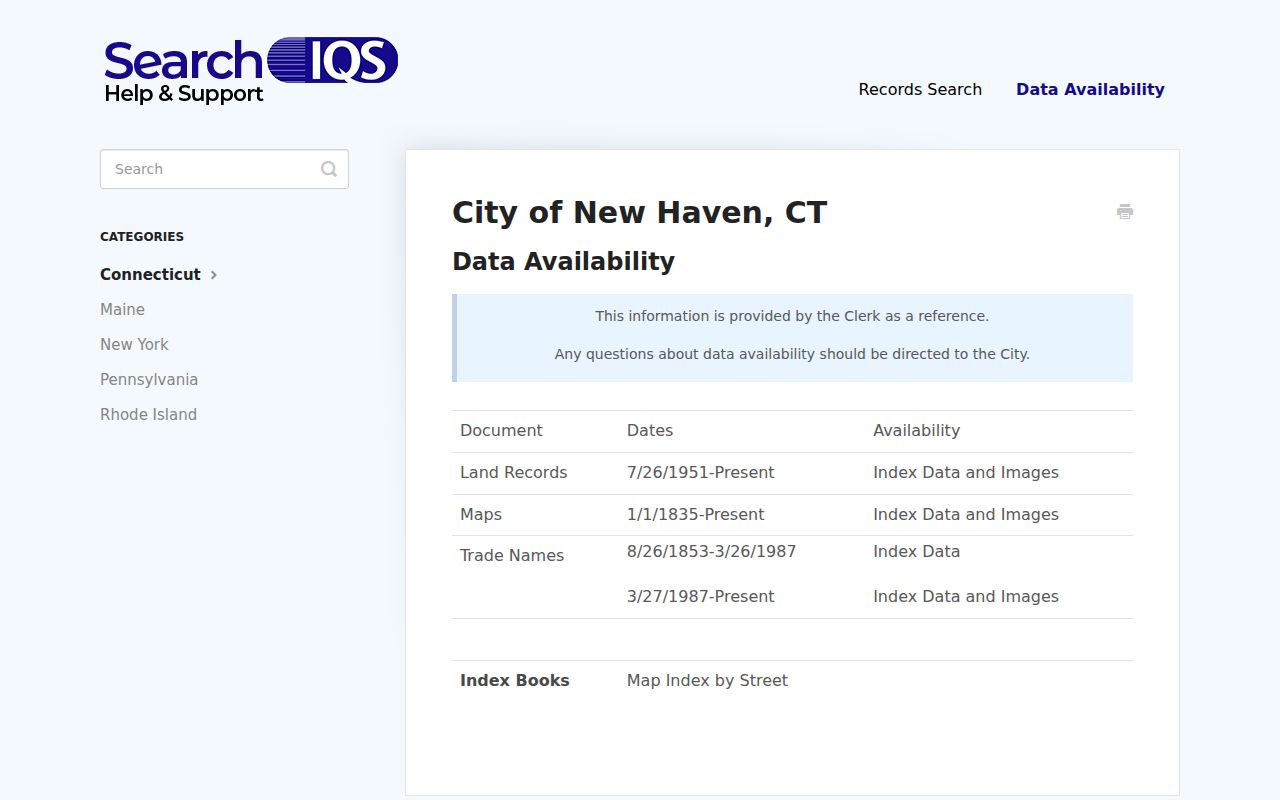
That online floor marks where the web property search begins, not where ownership history begins. Ask the City Clerk about older deed books and any images unavailable online.
Libraries Extend New Haven Owner Research
The New Haven Free Public Library holds newspapers on microfilm along with map collections. The Whitney Library at the New Haven Museum keeps city directories from 1830 through 1993, plus manuscripts, photographs, maps, and books. These materials can pin down an old street or an occupant. They cannot establish a transfer. Only a recorded deed does that.
The State Archives also holds New Haven County Court records from 1666 to 1855. A county court record can be genuine even though modern counties keep no deed office. Use that court context to locate the later municipal instrument in the property records.
Directory research works best as a dated cross-check. Record the exact printed address. Note the occupant or business name, the directory year, the edition, and a page or image reference. If a directory skips years, never treat the first listing you see as the acquisition date. Newspapers may report a sale, an estate, a subdivision, a foreclosure, or a street change. Such reports stay contextual until tied to a clerk's recorded deed.
Historic maps play a different role. A plan can reveal an earlier lot number. It may also show a development name, a former road, an adjoining owner, or a right-of-way. Compare that label with the deed description and later map references. Do not force an old plat onto a modern GIS map polygon. A nearby historic name on a map does not establish ownership. Note each map's title and date so every change stays visible.
Probate Breaks in New Haven Chains
An estate can interrupt a clean seller-to-buyer pattern. The Connecticut Probate case lookup covers online cases from January 5, 2011. It can identify a district, a case, or a fiduciary. An inventory or court order may explain who had authority to sign. The municipal deed still records the actual conveyance.
Build a timeline that runs from probate case to order and fiduciary appointment. Add deed execution, recording, and the eventual assessor update. Different names in the property records often reflect different roles and dates.
The right Probate Court turns on district. It also turns on domicile, not just the New Haven County label. New Haven Probate Court sits in District PD-38. A property elsewhere may still connect to a different district. When the public case display is thin, request the official inventory, order, or decree. Then locate the fiduciary deed and test its legal description against the prior deed.
Trusts and business entities create similar apparent breaks in a deed chain. Search the exact entity name as both grantee and grantor, keeping suffixes and punctuation intact. An entity registry helps sort similar names. It cannot replace the municipal deed. Document any merger, dissolution, trustee change, or name variation. Never silently treat parties as one.
Maps Repair New Haven Owner Trails
An old deed may cite a road, an adjoining owner, or a recorded plan rather than today's parcel number. New Haven map records reach well into the nineteenth century. A city grant once described an $11,000 aperture-card and map-book digitization project. That grant does not prove every map is online. Compare the old lot label against the modern GIS map, keeping the dates separate. Splits, merges, road changes, and common elements can each demand several deeds.
Clerk Channels for Previous Owners
The New Haven City Clerk offers a portal. It also runs a counter at 200 Orange Street, Room 202, open weekdays from 9:00 a.m. to 5:00 p.m. Waterbury documents in-person research, phone and email help, and copy requests. It also provides professional remote access to its property records. Meriden provides NewVision, counter assistance, and copies.
If a municipal record turns up missing, send a focused Connecticut FOI request. Address it to the actual custodian. Include the address, parcel number, parties, record type, and date range. FOI compels disclosure. It creates no countywide index.
Audit Each New Haven Transfer
A backward chain works best as a dated ledger. Each New Haven County transfer deserves its own row. For every one, capture the grantor, the grantee, and the deed type. Also capture the execution date, the recording date, and the book/page or instrument number. Add the part of the legal description that matches the parcel. Mortgages, releases, maps, and liens belong in a parallel note. They support the story, but none of them is an ownership transfer.
Treat nominal or zero-dollar sales entries with care. Meriden's 435 Bradley assessor card shows one example. It has a March 3, 1997 row at $0, recorded at book 2245, page 296. A visible sales-history value like that is not proof of a market price or a gift. Open the referenced instrument and read its terms yourself. Keep recorded consideration, assessor sales data, appraised value, and assessed value in separate columns. They answer different questions about the same property.
Sometimes a deed describes only part of a tract. In that case, follow the cited plan and the adjoining-owner calls. A later parcel number may reflect a split, a merger, a condominium unit, or a common element. It may never have existed under the earlier number. Record the uncertainty plainly, then continue with the municipal map books. Copying names from a directory is faster. This slower method preserves the evidence trail that makes former owners useful for real property history.
Note: Never bridge a missing deed with an assumption built only on a shared surname, street listing, or nearby parcel.
Keep a row for every interval you cannot resolve. List the last confirmed grantee, the next confirmed grantor, and the years searched. Also list the name variants tested and whether deed images were available. Then ask the town clerk about reverse indexes, older volumes, marginal references, or map books covering that gap. A transparent gap beats an invented former owner every time.
Limits of New Haven Owner History
No single cutoff date covers all 27 municipal chains. When a portal stops, keep going through clerk books, maps, phone calls, email, and in-person requests at the town office. Log each failed property search with its exact system, spelling, date span, and the date you ran it, since that record proves only what was checked.
Lawful use. Former-owner research supports house history, estate work, and property diligence. Never use owner data to stalk, harass, or target a person.
Need one instrument's full fields or copy routes? The New Haven County deed records page covers them. A complex chain reconstruction may still call for professional title review.