
Read New Haven County Tax Records
New Haven County property tax records are municipal records first. The assessor fixes the taxable assessment and applies any exemptions. The tax collector then sets the local rate against that value. It issues bills, posts each installment, and tracks what has been paid. A town clerk handles any tax lien or release recorded against the land. Each office answers a different question. A single result should not collapse all of those roles together.
| Field | What It Shows | Where |
|---|---|---|
| Assessed value | The taxable value for the Grand List year | Municipal assessor |
| Market or appraised value | The assessor's full-value estimate | Assessor card or CAMA database |
| Exemptions | Relief applied to the assessment, including qualifying veteran relief | Municipal assessor |
| Bill and balance | Tax type, installment, amount, due status, and payment | Municipal tax collector |
| Lien or release | A recorded claim or later discharge tied to unpaid tax | Town or city clerk land records |
Connecticut municipalities generally assess real estate at 70 percent of fair market value. That ratio is not a sale estimate. The assessed value reflects a valuation date and a Grand List. It is not what a buyer paid. A deed price records one transfer, and its terms can be nominal or unusual. For a closer look at those figures, see the New Haven County property value record.
New Haven Tax Search Fields
The New Haven tax-bill lookup offers several routes into a city account. A name search takes last name, a space, and first initial. Skip the comma and other punctuation. On the property-number route, leave off the street suffix. Bill numbers follow a year-type-number format. Account and link numbers sit under separate choices.
| Search choice | Input rule | Useful result |
|---|---|---|
| Name | Last name, space, first initial; business name also accepted | Accounts associated with that billing name |
| Property number/name | Enter the property number first; omit street suffix | Real-property bill candidates |
| Bill number | Year-type-number | A specific bill |
| Account number | Exact local account key | Account history and balance display |
| Status filters | All, Due Now, or Balance Due | Narrows current payment questions |
The page splits real estate, personal property, and motor vehicle tax types. It also posts the account-information update date. It warns that municipal records control if the web data differs. Copy that date along with the result. A tax account label may not match the parcel's MBL. It may also differ from the deed's book and page.
The live search screen on the portal shows these controls directly. Open the official New Haven tax lookup before using them.
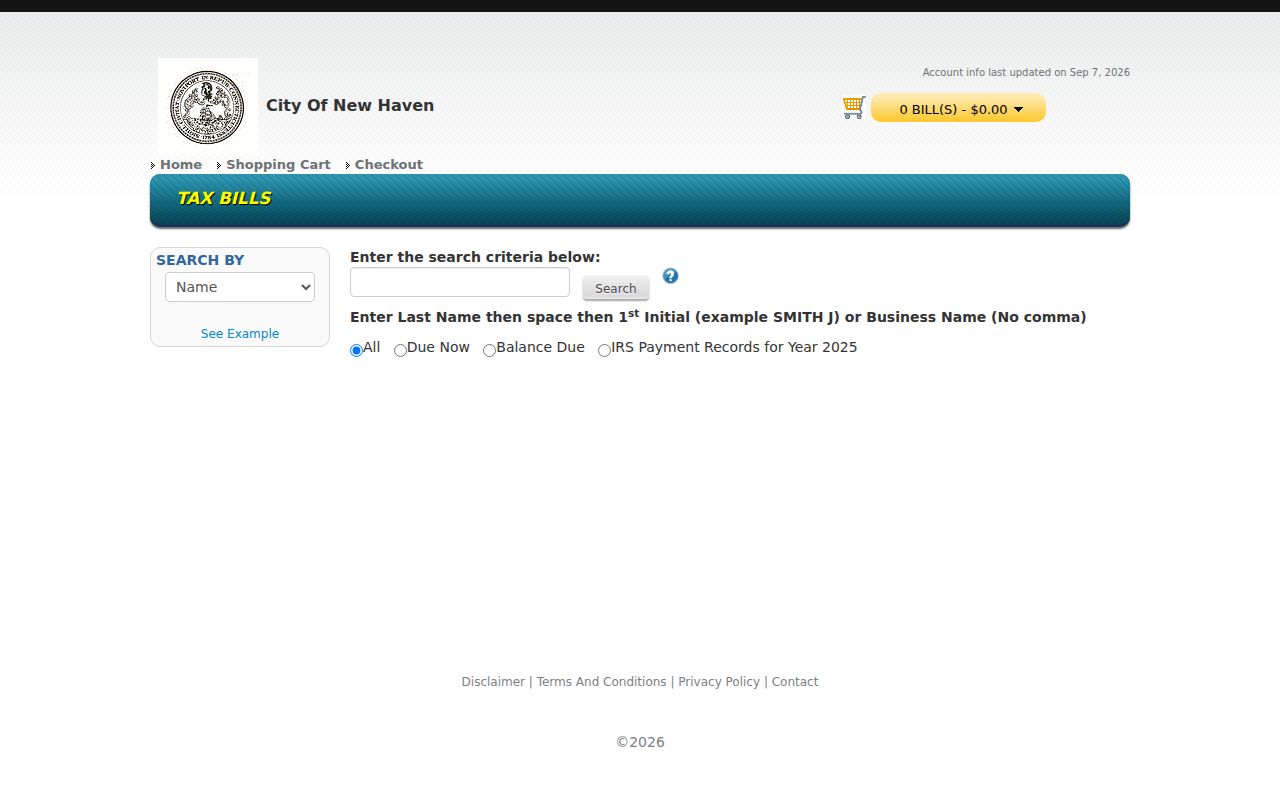
The bill portal is account-based, and it offers several distinct paths rather than one countywide parcel search.
New Haven County Bill Routes
Access varies across the county's 27 municipalities. New Haven supports the public web search. The Tax Collector Division sits at 165 Church Street. Waterbury offers an online payment and inquiry route, an office at 235 Grand Street, and mail to PO Box 2216. Its published real-estate schedule uses July and January installments. Bills of $200 or less are due in a single payment.
Never carry Waterbury's rules over to Meriden or another town. Where a portal is unclear, contact that municipality's tax collector. Request an official balance by address and local account or parcel identifier. A missing bill can still be traced at the office. When a portal blocks access, a Connecticut FOI request can obtain an existing agency record. It cannot create a countywide tax report, though. The official Waterbury tax page shows its own city-specific inquiry and payment route.
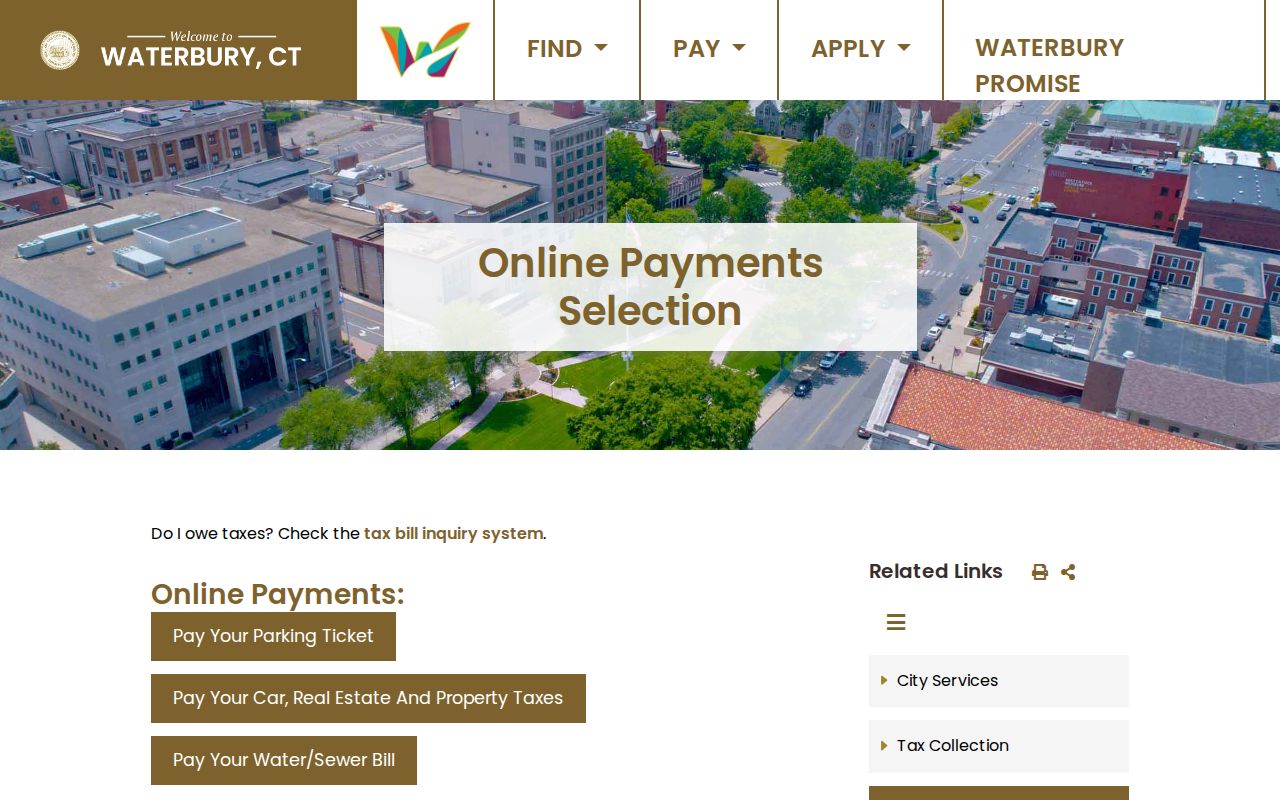
The routing rule stays simple: use each municipality's own tax source, and never import another city's calendar.
Note: Use the legal municipality, not just the postal city, when a parcel lies near a town boundary.
Trace a New Haven County Tax Bill
A sound lookup keeps assessment, billing, and recorded instruments in sequence. Start with the correct town. Save the exact labels and the portal's update date rather than assuming every identifier is a parcel number.
- Search the municipal tax portal by address, owner spelling, account, and any property-number option. Save the account key and update date.
- Read the tax type, Grand List year, installment, amount, balance, and payment status. Distinguish real estate from business personal property.
- Open the municipal assessor card. Compare the assessment year, value components, and any exemption or penalty notice.
- Search the municipal land-record index for tax liens and releases. A balance alone does not prove a recorded lien.
- Contact the tax collector for an official balance or certified statement when a purchase, closing, or dispute requires it.
- Assessed value
- The amount placed on the Grand List for tax use, generally 70 percent of fair market value for real estate.
- Mill rate
- Tax charged per $1,000 of assessed value.
- Exemption
- A qualifying reduction applied by the assessor; the displayed database may not reflect every exemption or penalty.
- Tax lien
- A claim recorded in municipal land records. It is distinct from an unpaid balance shown in a bill portal.
New Haven Property Tax Timing
The New Haven Tax Collector Division published a specific snapshot for the 2025 Grand List. The first installment was due July 1, 2026. It was payable without the stated penalty through August 3. Delinquency began August 4. The listed real-estate and personal-property mill rate was 39.962. Those are dated city figures, not New Haven County property tax rules.
The same page explains the math as one dollar per $1,000 of assessed value. It notes holds on some check and ACH payments. Its FAQ advises keeping tax receipts for 15 years. Check the current municipal notice before paying. Dates, rates, and account status all change.
The municipal split matters here. A Waterbury installment rule or a New Haven rate cannot be applied to a Meriden parcel. One New Haven County property tax search therefore cannot put every town on a single calendar.
Separate Tax Debt From Liens
A tax portal can show that money is due. It cannot, by itself, prove that a lien has been recorded. Search the town clerk's land-record index by owner and document type. Then inspect the instrument or order a certified copy. Record the lienor, owner, property, recording date, book and page or instrument number, amount if shown, and any later release.
A foreclosure or judgment adds another source. Search the Connecticut Judicial Branch civil inquiry. Then verify the case file with the court clerk. The land record may later show a committee deed, release, or certificate. These systems update on different dates. Save dates and dispositions rather than treating one hit as current debt.
Three-record check. A tax balance, recorded tax lien, and foreclosure case are distinct records. Verify each with its municipal or court custodian.
New Haven County Assessment Dates
New Haven says its Grand List includes assessments, exemptions, and ownership as of October 1. The city kept assessments for 2021 through 2025 at the 2021 revaluation level and is conducting a revaluation for October 1, 2026. Preliminary notices, informal vendor hearings, final values, and the Board of Assessment Appeals occur in sequence. A later sale does not automatically reset the published assessment.
Meriden follows a different calendar. Its official VGSI notice states that the 2025 revaluation reflects fair market value as of October 1, 2025 and applies the 70 percent assessment level. Second notices went out February 27, 2026, and the written appeal deadline was March 20, 2026. Meriden also warned against applying the old mill rate to a new assessment.
The contrast shows why every New Haven County property tax record needs a municipality and Grand List year. One city's active revaluation cannot establish another's value date.
Challenge a New Haven County Assessment
Assessment appeals belong to the municipality, not a county board. New Haven's Board of Assessment Appeals hears real estate matters in March. The written filing must arrive before February 20, and an appearance is required. Expect the application to ask for the owner, contact details, and property type. It also wants the street location, account or unique ID, and property use. Add the reason, claimed fair-market value, and signature. Agent authorization is needed when one is used.
Start with the assessor and the current Grand List. Bring the field card, photos, and corrected property facts. Include comparable records on the same valuation basis, plus any evidence tied to the valuation date. A tax-collector dispute is not a value appeal. New Haven notes a Superior Court route opens within 60 days after the board's decision. Meriden's dates differ, so use the form for the parcel's own municipality and year.
Appeal window. New Haven requires the written appeal to arrive before February 20. Confirm the current municipal deadline before filing.
Verify New Haven County Tax Notices
Property-related mail can imitate a real tax demand. Connecticut consumer alerts describe urgent letters with phrases like "final notice" or "call immediately." Some of these come with forged documents and deed fraud. Match any bill, payoff demand, lien notice, or copy offer to the official municipal account before sending money.
Go direct. Type or follow the municipality's official address. Compare the bill number and account. Call the published tax-collector number. If a recorded instrument is cited, locate it in the clerk's index. An unfamiliar record is not proof of fraud. Keep the notice, then ask the custodian to confirm it.
New Haven County has no county tax collector who can validate all 27 towns. That local geography is the key safeguard. It is why every tax result needs its town name.